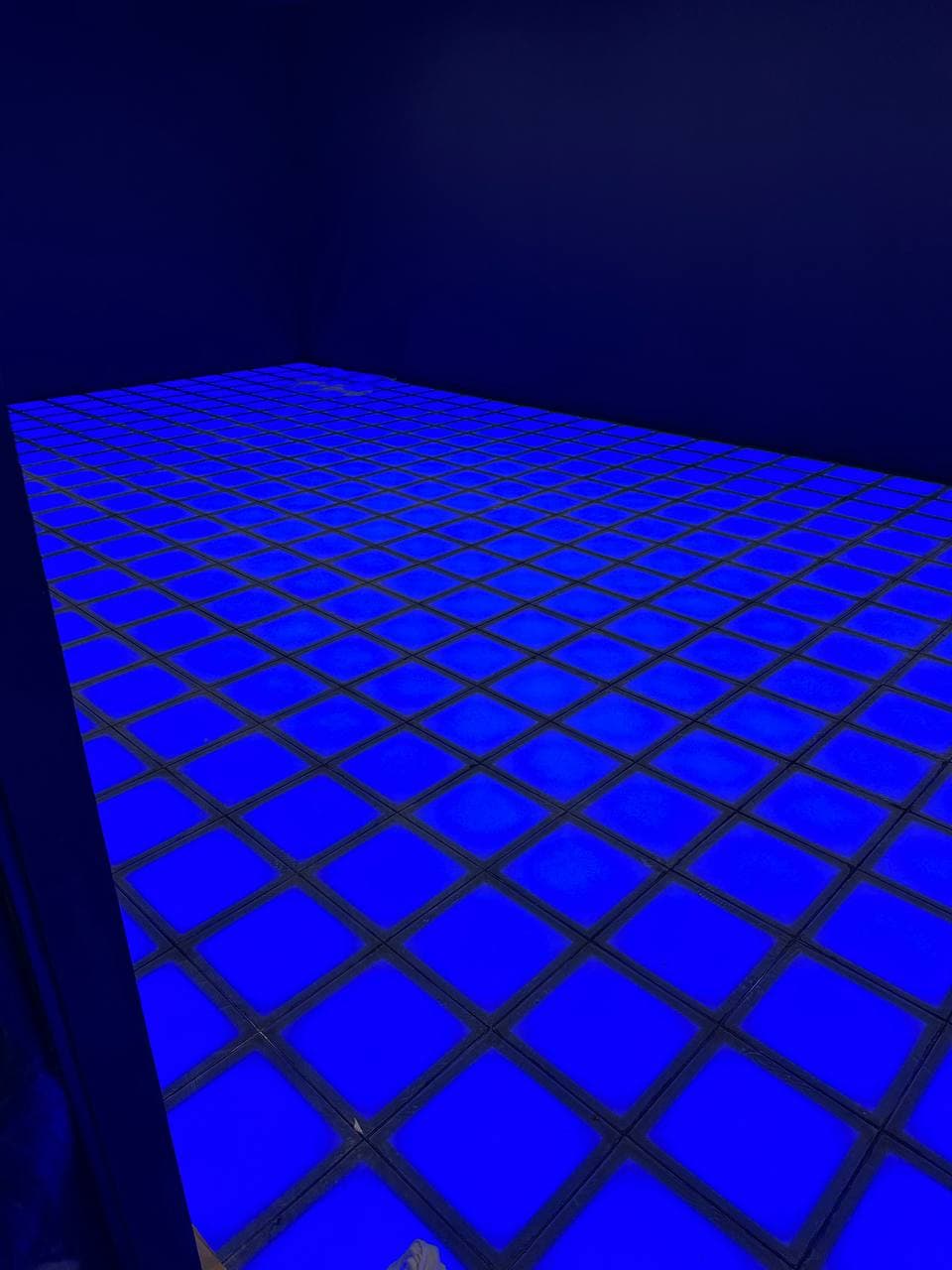
A room becomes the game
GriddyGrid turns sensor-equipped LED floor tiles into an interactive play space. Players’ physical movement becomes input to C++ game logic, and the floor responds through lighting. The platform supported installations of approximately 640 or 1,280 tiles, connecting configurable game behaviour to physical devices.
My role from research to deployment
I led four developers during a contracted, part-time engagement with Daltech. My responsibilities included engine architecture, core tooling, game logic and hardware networking. I also coordinated with the LED-controller supplier and helped establish the initial hardware connection. Once the integration was working, I divided team work across content, mechanics and testing.
A custom C++ engine and authoring foundation
I designed and implemented the engine architecture, application window, GUI, ECS, reflection and serialization systems. These provided a shared foundation for developing the installation’s games and programmable experiences. Separating game behaviour from device coordination allowed the platform to support configurable experiences and modular expansion.
From MADRIX-assisted testing to direct control
The first hardware milestone was lighting a single tile and observing its sensor input. Supplier support and MADRIX helped establish that connection before expanding to the full floor. I subsequently replaced the MADRIX application dependency with direct, in-house hardware communication, bringing device coordination into the C++ platform.
Two directions of real-time communication
I built packet conversion and multithreaded UDP/ART-NET networking to send lighting frames and receive binary capacitive tile-press sensor frames. These are separate responsibilities: output communicates the visual state, while incoming sensor data feeds the game’s interaction model. I separated data access by design to avoid conflicting operations between those responsibilities.
Debugging the hardware boundary
The integration required matching packet fields, universe mapping and colour-channel layouts to the controllers’ expectations. Wireshark made it possible to inspect the actual traffic and diagnose communication problems. Testing also exposed the practical limits of wireless networking as traffic increased toward launch, making Ethernet an important part of reliable operation.
Delivery and commercial context
The Singapore venue launched in May 2024. The recorded launch results were US$200K in revenue and 2.5k unique customers over seven months; these describe the business outcome around the installation. GriddyGrid was also featured in MADRIX’s Best of 2024 showcase. My engineering role extended through deployment and supplier coordination, alongside the wider team’s development work.
What this work taught me
This was my first hardware-networking project, and it turned a simple idea—send colours to tiles—into an exercise in protocol integration, controller behaviour and real deployment conditions. It connected my interest in reusable C++ architecture to a physical installation where inputs, game state and visible output all had to work together.